Your web designer says you need an accessibility statement. It is a short page that tells a customer who gets stuck on your site how to reach you, and what you already know isn’t working. Neither the W3C nor the Justice Department’s web guidance says a US business has to post one, and the page fixes nothing on the site by itself. Written honestly, it still earns an afternoon, because it puts a working phone number in front of the person your site just failed.
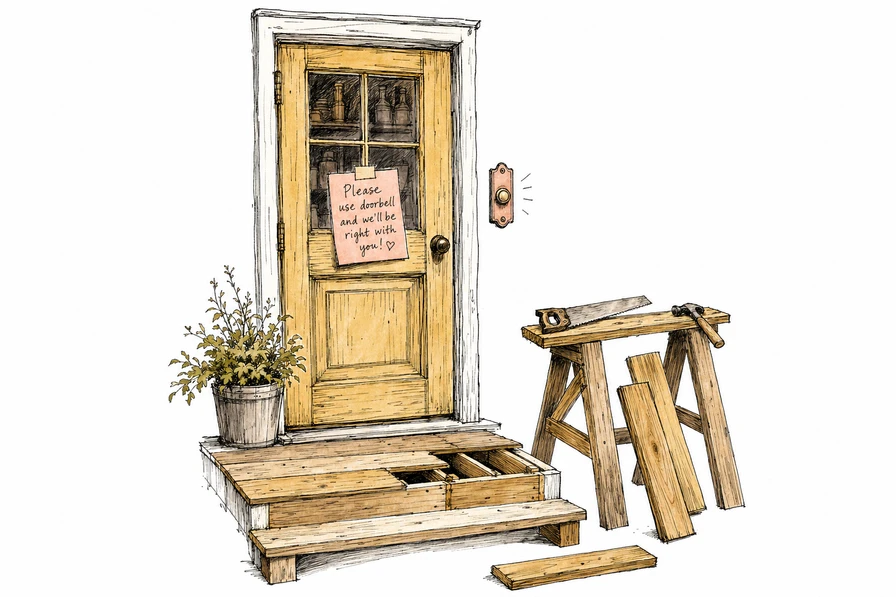
Think of it as the note taped to a shop’s side door: the front step is being rebuilt, ring here and we’ll come out. The step is still broken, and the customer still gets served.
What goes in an accessibility statement?
The W3C, which publishes WCAG, the standard courts reference, sets the minimum: “A commitment to accessibility for people with disabilities,” “The accessibility standard applied, such as WCAG 2.2,” and “Contact information in case users encounter problems.” It also advises listing “Any known limitations, to avoid frustration of your users.”
For a twelve-attorney firm, that can be five plain lines:
- We want everyone to be able to use this site, including people with disabilities.
- We are working toward WCAG 2.1 AA, the standard courts reference.
- Right now, the map on our Contact page has no description a screen reader can read, so our address and directions are written out beside it.
- If anything on this site stops you, call (555) 010-0199 or email access@yourfirm.com, and we will answer within two business days.
- Last reviewed November 3, 2026.
Keep it in plain words. The W3C’s own example: say “videos do not have captions,” never a criterion number.
Does an accessibility statement protect me from a lawsuit?
Nothing we read says it does. The W3C calls statements “not technical assessments or declarations of conformity.” The Justice Department’s web guidance never uses the phrase. What DOJ does recommend is the contact line: “Websites that provide a way for the public to report accessibility problems allow website owners to fix accessibility issues.”
The risk runs the other way, through the one sentence to leave out: “this website is fully ADA compliant.” That is a legal conclusion stated as fact, in public, on a page anyone can test. Even the W3C’s sample statement calls its imaginary store “partially conformant.” And in 2025 the FTC ordered accessiBe to pay $1 million and barred it from claiming its automated products can make any website WCAG-compliant without evidence to back it.
Where should the statement go?
In the footer, the W3C suggests, so it is one click from every page. It is rarer than you might expect: when we checked the sites of 16 web design and marketing firms in the Reno + Sparks chamber directory in September, 3 linked an accessibility statement, and those firms build websites for a living.
Before you write the “known limitations” line, find out what they are. Our free report lists what a machine can detect on your pages, and four checks you can do yourself cover some of what it can’t. If someone told you to add a widget instead, read this first. We sell the fix, so weigh our advice with that in mind. Just as useful on a client’s site, if you’re advising one.
The note on the side door earns its place while someone is rebuilding the step.
The fine print
- We’re not lawyers, and none of this is legal advice. Whether the ADA reaches a website at all is split by circuit; see Does the ADA apply to my website?
- Where we looked for a requirement. The W3C names one case where a statement may be required: “public bodies in countries that implement the EU Web Accessibility Directive.” DOJ’s 2022 guidance does not contain the phrase “accessibility statement.” We did not find a US rule requiring a private business to post one; that is “not found,” not “none exists.”
- Courts. A keyword search of court opinions on CourtListener (Nov. 2, 2026) found no holding that a statement is required, protects a business, or creates liability. That search reads court opinions; settlements are not in it.
- DOJ’s guidance is guidance. It says the Department “does not have a regulation setting out detailed standards” for businesses’ websites. No court holding we found adopts WCAG as the legal standard; courts reference it. “ADA compliant” is a legal conclusion, which is why the sample above says “working toward.”
- The FTC order is a “final consent order,” the FTC’s words; it is an agreed order, not a court ruling. accessiBe sells an overlay widget, accessWidget.
- The Reno figure is from our own check on Sept. 29, 2026 of 16 web design and marketing businesses from the Reno + Sparks Chamber of Commerce member directory, reading the HTML each site served for a link to an accessibility statement. A link added later by a script would not show, so 3 of 16 is a floor. No business is named here.
- A scan sets a floor. A clean result means nothing machine-detectable turned up. It is not proof a site meets WCAG 2 AA.
- We sell remediation and testing, so we have an interest in you fixing your site.
Sources
- W3C WAI, “Developing an Accessibility Statement,” updated Mar. 11, 2021 — https://www.w3.org/WAI/planning/statements/
- W3C WAI, “Example of Minimal Accessibility Statement” — https://www.w3.org/WAI/planning/statements/minimal-example/
- U.S. Department of Justice, “Guidance on Web Accessibility and the ADA,” Mar. 18, 2022 — https://www.ada.gov/resources/web-guidance/
- Federal Trade Commission, “FTC Approves Final Order Requiring accessiBe to Pay $1 Million,” Apr. 22, 2025 — https://www.ftc.gov/news-events/news/press-releases/2025/04/ftc-approves-final-order-requiring-accessibe-pay-1-million
- W3C, Web Content Accessibility Guidelines (WCAG) 2.1 — https://www.w3.org/TR/WCAG21/
- Guava scan, Reno chamber web agencies, Sept. 29, 2026 —
research/scan-harness/FINDINGS-web-agencies-reno-2026-09-29.md